Weekly newsletter highlighting the latest AI news, with short video tutorials and copy/paste prompts you can use to improve your skills as an AI operator. As artificial intelligence moves from optional to operational, technical specialists no longer have the advantage. It is those who can supervise and coach AI to improve that will thrive in an AI-augmented future.
Reward Yourself for Inbox Zero
Hello Reader,
I was in the middle of mighty-tasking when I had a brilliant idea.
This idea had nothing to do with the project I was working on. If I had stopped to tend to this idea properly, it would derail the state of flow I had achieved.
I did not want to sacrifice my current project for a new idea, even if it was brilliant. I’ve learned the hard way: shiny, new ideas might turn out to be dull after a while, and switching out of a state of flow forfeits your creative momentum.
So I quickly grabbed a scrap of paper, wrote three words that would remind me of the idea, and dropped it into my inbox. Without missing a beat, I stayed in my state of flow.
My current project was not damaged, and my future project was waiting for me, in a system where I could retrieve it later.
Don’t remember things, let your system do it for you
In his book Getting Things Done, David Allen tells a story about remembering the milk.
Imagine you are in an office meeting at 10 in the morning, he said, and you have a thought: I need to remember to get milk on the way home! So you think about that during the meeting, to be sure you don’t forget. During your lunch break, you remind yourself, ‘don’t forget the milk.’ All afternoon, your inner monologue keeps repeating, ‘Remember the milk!’ So by the time you leave the office and are on your way home, you’ve been thinking about it all day.
This is not an efficient use of your brainpower.
Now imagine sitting in that meeting, and you remember you have to get milk on the way home. You take out your phone, set an alarm for 5:02 with the label ‘Remember the milk’ and you forget about it for the rest of the day.
This frees your mind to do the things it’s actually good at doing: collecting ideas, sorting them, and archiving them for later use. Having ‘too much to do’ is a symptom of not knowing where everything is, or what to do with it.
If you use your conscious mind to hold an idea, it’s just like using your computer memory inefficiently, and slowing down your processing power.
Every computer has two types of memory: ROM and RAM. Read-only memory is for deep storage. It’s your hard drive. ROM can hold your family photo archive, large movie files, and the big fancy programs that take up lots of space. At the time of this writing, 1 Terabyte is a typical size for a computer hard drive.
Random Access Memory is generally from 16-32 Gigabytes on an average computer, a fraction of the size of the ROM. RAM determines how fast your computer can go. It does not store your data, it moves data quickly between different parts of the computer. It makes fast computations, shows you flashy visuals, and loads your programs.
If the ROM is your brain, the RAM is your hands, moving things from place to place. You are limited in how many objects you can hold in your hands, while you are unlimited in how many objects you can hold in your mind.
Remembering the milk with your conscious mind is like using your RAM for deep storage. It slows everything down, because your processing power is clogged by holding onto something big.
Imagine holding a large jug of milk in your hands, and holding it all day, so you don’t forget to bring it home. That’s what you’re doing when you hold ideas. If you can transfer your ideas to a system that you trust, then you can free your mind for higher-level thinking.
Everything goes in the inbox
An inbox collects all outstanding items for your attention into one place, no matter what it is. Having a default destination means you don’t have to pause and sort the idea, and figure out what to do with it; you can get it out of your attention until later.
Your inbox can be physical, or virtual, or a combination of both. It’s the collection point for everything that needs your attention later, and it’s portable, so you can put it aside to focus on whatever needs your attention right now.
Life Architect surveyed hundreds of Dutch workers in 2009 for a Productivity Scan research study for GTD co, with questions like ‘I feel that I spend my time on the right things.’ After learning GTD, participants average scores went up by 20%. In another survey, 87% of employees said they handled email better after learning GTD.
Time spent searching for your own ideas and documents is wasted time
The GTD system can get very complex, and if you want to study their complicated workflows, get David Allen’s book and magnify your ability to get things done.
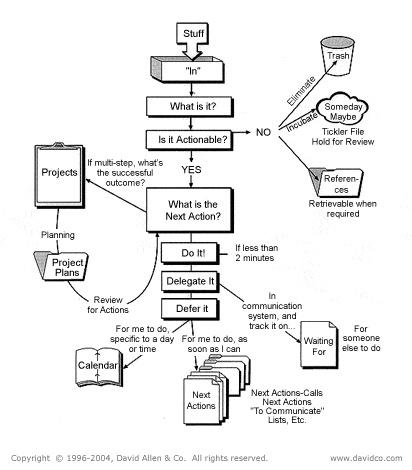 |
The full GTD system frames the stages of your workflow as Capture, Clarify, Organize, Review, and Engage.
But if you want the simple version, the GTD system consists of five main activities:
- Collect everything in a universal inbox
- Set aside time for a Weekly Review to empty the inbox
- Ask of any task on your list: What’s the next action?
- For every task: do it, delegate it, defer it, or delete it
- If it takes less than 2 minutes, do it right then.
The beauty of this system is that it is completely customizable to you and your process. I use Things by Cultured Code as my digital inbox. It’s Mac only, but there are plenty of GTD apps (like the one called Remember The Milk) that use this framework for amplifying your productivity and getting things done.
An inbox keeps your mind clear & your desktop clean
Putting down new ideas safely preserves your focus. If your mind is always full, you have no room for anything new.
When you have a place to put anything and everything down, you can pick new things up. The benefit of the inbox is that you don’t have to sort it immediately - you capture everything in the moment, and sort it later.
A final warning: beware of too much efficiency. Efficiency is getting lots of things done, while effectiveness is doing the right things. Your personal productivity system can serve you or thwart you.
If you have a long to-do list that isn’t moving, ask these three questions of every outstanding item on your list:
- Does this task need to start with a verb?
- Can I take the next action?
- Can I do this in 2 minutes?
Remember the two minute rule: if it takes less than 2 minutes, do it right then. This will keep your inbox from overflowing, and free up your mental (and physical) space for larger projects that need your full attention.
Reward Yourself for Inbox Zero
Inbox Zero is a magical state, where everything is ordered and organized, and anything left undone is waiting for you in a system where it can be attended to at the right time.
I think Inbox Zero deserves a reward.
Anytime I empty my inbox, I indulge myself with dancing for five minutes in my studio. I don’t do make it to Inbox Zero every week, but when I do, I take the time to celebrate the accomplishment with a midday dance to my favorite music.
You can also reward yourself for:
- Answering all your emails
- Filing that pile of documents
- Finishing the project you’ve been putting off
Next to your To-Do List, write a Reward List.
Give yourself incentives to do the hard work that needs to get done.
AI Coaching Newsletter
Weekly newsletter highlighting the latest AI news, with short video tutorials and copy/paste prompts you can use to improve your skills as an AI operator. As artificial intelligence moves from optional to operational, technical specialists no longer have the advantage. It is those who can supervise and coach AI to improve that will thrive in an AI-augmented future.
📊 “Context engineering is the strategic process of selecting, packaging, and managing the most relevant information for each step.” - Antonio Gullí Hello Reader, In July 2025, Gartner told AI leaders that “context engineering is in, and prompt engineering is out.” The past year, people on the bleeding edge of AI have been paying attention to framing. 💡 Context engineering prepares everything prior to the prompt. Even the best prompts will fail without the right context. Giving AI backstory...
🗂️ "An AI Agent runs tools in a loop to achieve a goal." - Simon Willison Hello Reader, Generative AI makes things for you. Agentic AI does things for you. This distinction, between making and doing, is the next step on the exponential curve of capability. An AI Agent can initiate and execute tasks independently, finding the best way to transition from an initial state to a goal state by using any tools it has available, as often as it is capable of doing. In his excellent primer on AI...
🌱 “It’s clear that we are well into the adoption phase of AI, but not everyone is adapting.” - Lou Compagnone Hello Reader, I was in Wellington this week for the #AotearoaAISummit, the annual festival hosted by the AI Forum New Zealand. I livetweeted the event on LinkedIn (live-posted? doesn't have the same flavour) on the hashtag linked above, and I made AI anime illustrations of all the speakers. You can see my takeaways (and my art) below: (Please note - other than the illustrations, no AI...